One of the things that makes my heart melt is that Baby J. absolutely loves his big sister Little L. He turns his little head, searching for her when he hears her voice, and he gives her the biggest smiles and giggles. It's such a sweet thing, as a mom, to see how the two of them are becoming familiar to one another, little by little, becoming friends.
Tonight at bedtime Little L. had a great idea. She asked if I could videotape her reading a story for Baby J. so that he could watch it while she was at school tomorrow. "In case he was missing me," she said.
Baby J. is too young to watch videos, but I'm glad I have this video so that I can watch it... in case I'm the one missing her.
P.S. To find out more about how we've been supporting Little L with her reading at home, and to get ideas for supporting the emergent readers in your life at home or in the classroom, see this old post: Shared Reading With Your Tiny Reader.
It was the end of a very long, tiresome day. Baby J. was about four weeks old. I climbed the steps to Little L.'s preschool classroom one by one, each step taking much more effort than usual. I couldn't figure out any good way to hold Baby J.'s car seat that didn't hurt my arms, wrists, and hands. I had to stop at the landing to catch my breath. Finally I reached the top of the steps and opened the door to the classroom.
Little L. was wrapped around me in a flash. "Mommmmmy!" Her face was shining, so happy to see me.
My heart felt warm, but there was also a pinch of guilt. This was the first time that I had picked her up from school since the baby was born. I used to pick her up every day.
L. latched herself on to me as I put my initials on the sign-out sheet and started gathering her things from her cubby. That's when I noticed a little blue gift bag. I knew that it would be for Baby J. so I tried to hide it among the backpack, lunch bag, and projects going home.
"What was that?" L. demanded to know.
"Let's put on your boots!" I said with enthusiasm. I wanted to avoid a scene over the gift.
"Is that for the baby?" she said.
I pretended not to hear her. "Boots time!"
"Mommy, I know that that is for the baby." Little L. was using her "teacher voice," to let me know that I wasn't fooling anybody by hiding that gift.
The guilt pinch got stronger. She proceeded to put on her boots, then her coat.
Gifts had been pouring in for the baby over the past few weeks and I worried that L. was feeling a little sensitive about it. We had done the best we could not to make a big deal about presents for the baby, opening them on our own most of the time. Sometimes a thoughtful friend or family member would include something for L. and we'd let her open hers first.
But then, amazingly, miraculously, she said cheerfully, "Let's see what is it! Is it another hat?" (L. loves J.'s hats for some reason). "Can I open it for him?"
I was shocked. Little L. didn't seem to care that J. was getting a present. She genuinely seemed interested in what he was going to get.
The present was adorable (Thank you A. & M.!) and L. couldn't wait to see Baby J. try it on.
The next morning, Little L. decided to write a thank you note to her friend:
Moral of the story: Maybe I've been underestimating Little L.!
PS In another post, at another time, I really want to point out all the great emergent writing behaviors going on in this video clip, but I'll save it. It's hard to turn off my teacher brain!
Whew! We just had the busiest weekend ever! Saturday for Little L went like this:
10:00am Teddy Bear Tea Party
11:00am Special Lunch at Gardeners Cafe
12:00pm Parents Day at Little L.'s Preschool
That' a lot of excitement for a four year old in one day. Then today went like this:
11:00am Cousin J. came over to play
1:00pm Go to Casey's Hill for sledding with Cousin J., K, and M
4:00pm Grandma and Grandpa and Great-Grandma came over for dinner
With all this great stuff going on, it was hard for my little coauthor and I to squeeze in some storytelling for the SOLSC. Then, when we finally did have a minute, we had a hard time coming up with ideas.
So, what do you do when you can't think of an idea for a story? Here a just few things I do:
1. Think of a true story that really happened
2. Think of people or places that matter most to me, then think of one thing that happened
3. Think of a person I'd like to tell a story to, and make up a story just for them
4. Look at pictures or videoclips to get ideas
5. Draw a picture of things I like to do, then tell the story of one time
6. Think of stories or books or movies I love, and write my own version
In today's SOLSC Little L. tells her own version of a story that is very familiar to her. See if you can guess what story she is adapting (don't cheat by looking below!):
Peter Rabbit has been a topic of conversation quite a bit lately. She has a porcelain place setting decorated with Peter Rabbit and other Beatrix Potter characters that was my husband's when he was a child, and I think this sparked her interest. She also has a complete set of Beatrix Potter books that was a gift one year, and she's enthralled by the stories. The beautiful language captivates her. The gorgeous illustrations and little child-sized hardcover bindings are absolutely enchanting. The thing that I think interests her the most, and the thing that is the most surprising to me as an adult…. is that the stories are shockingly violent… in a way that I think scares her just a little, but not enough that she dislikes them. There really isn't a better word to describe them, but violent.Funny, I must have read the same set of stories a hundred times when I was little but I don't remember them being so violent. I guess I must have been so swept away by the child-size covers and adorable pictures that I didn't even notice that characters were risking limb, and losing life on every other page!
What about you, dear readers. What familiar stories did you love to retell when you were young? Do your students or your own children retell old favorites? Leave a title in the comment section!
In preschool and kindergarten classrooms, "shared reading" is a method that teachers often use to introduce young children to concepts about print and the beginning stages of reading on their own.
Essentially, shared reading is when you and a child (or group of children) read a book together. The book is read over and over again so that the child becomes so familiar with the how the story goes that she can chime in and "read" along with you. (So make sure to pick really fun books!) Usually we use short, predictable texts so that it's easy for the child to learn how the words go, making it fun and enjoyable to read along with you, matching her voice to each word you point to.
Little L. and I have been doing a lot of shared reading lately, using short, easy, beginner reading books--the kind that you would see in almost any pre-k, kindergarten, or first grade classroom.
We love the Brand New Readers Series. I use these little books often in my work as a literacy consultant, and it's exciting to see how much Little L. loves them!
There are tons of different characters to choose from in this series. Here are a few of our favorite characters from Brand New Readers. There are numerous titles for each character, so you and your child get to read about Monkey, or Mouse, or Worm in many stories, not just one :
Shared reading involves lots of rereading, which is great because it allows you to focus on something different each time you read the book. Usually the first time through, I read it just like I would read aloud any other book, only I do make sure to point to the words, and I use my voice to make the pattern stand out.
The second time through I continue to point to the words, and I also might let my voice trail off so that Little L. can fill in the missing words. She looks in the picture, and she knows how the pattern goes, so she's able to figure out the words I leave out. Substituting and filling in words that make sense is an important first phase in learning to read!
I've been keeping L.'s shared reading books in a special bag on her bookshelf next to her bed. We read 2-3 of these before her regular bedtime stories, which are usually longer storybooks or a few chapters from a chapter book. She loves that she gets to have a few extra books before bed, and they're so short that it only extends bedtime by a few minutes. As we reread our books, over time, Little L. chimes in more and more, and eventually she points to the words and "reads" the whole thing herself!
Some parents will ask me, "But aren't they just memorizing it? That's not really reading is it?" Well, yes and no. When your child knows exactly how the book goes, he or she is able to put together many reading skills at once: using the picture to figure out what's happening on that page, pointing to one word at a time, making sure to say words that match what's happening on the page, turning one page at a time, reading with expression… and much more. All of these skills can come together somewhat easily when your child knows the story, even when they might not be able to practice these skills at all on "cold read."
And if you're more of a researcher type, you should check out Don Holdaway's work (he's known to many as the guru of shared reading). Here's a link to a lovely youtube video that nicely summarizes some of his work.
Check it out! Little L. read to us at bedtime tonight! Notice how she's using the picture to help her figure out what each page says, pointing under the words, and doing lots of stopping and thinking along the way. Our little reader!
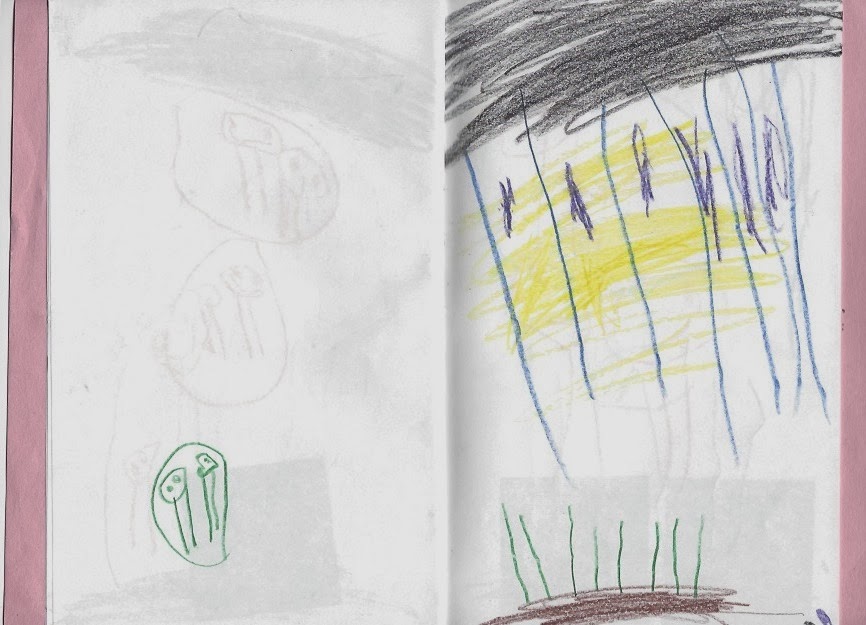
Here's Little L.'s latest book! She drew it and told it all by herself! The captions are her words exactly. Enjoy!
By Lily, [Book] 1
"The title is Color."
Page left: "First the little girl and her daddy woke up."
Page right: "And then they played outside in the SUNSHINE!"
"And they played outside, and then they went to sleep, and then it was night time."
"And then the next morning, it was thundering and lightening and rainy. The little girl and her daddy waited for the storm to pass."
Page left: "It's sunny and then the little girl and her daddy go out to play. But before they knew it, a storm was coming. They heard the thunder off in the distance."
Page right: "Then they hurried inside."
"And now for the final page. It's sunny again through all those storms. The sun was shining brighter than they had ever seen in their house. And they lived happily ever after."
THE END
And here's how she did it:
1. I stapled together pages of white printer paper, and asked L., "Would you like to make a book?" I said this with lots of enthusiasm, like an invitation to do something really, really special.
2. I pointed to the first page and said, "What happens first?" She told me the story aloud first, and then I said, "Great story! Draw it!" and she went to town.
3. As soon as she had drawn everything that she wanted for the first pages of her story, I turned the page and said, "What happens next?" She told me, and then again I said, "Wow! Draw it so we don't forget it!"
4. I continued this way, nudging her to turn the page before putting the whole story on one page, and asking her to tell the story aloud before drawing. As we neared the final page of the book, she started planning out how the story would end. As she drew the last few pages she told the story aloud several different ways, finally deciding on the beautiful ending that you see in her book.
Some tips:
1. Encourage your children do their own work all by themselves, with minimal intervention from you. For example, when L. first got started she turned to me and said, "I don't know how to draw a house. Draw it for me." I said, "Well, think about the shape of a house. It's kind of like a square." On a separate piece of paper I drew a very simple square shaped house. L. looked at it, and said, "I'm just going to do it this way." And she drew a circle around the little girl and her daddy to represent their house.
2. Be proud of whatever stage your child is at. When L. was still in the scribbling stage (which she still enjoys quite a bit), I would still say, "Wow, tell me about this!" or "What's happening on this page?" To her, those little squiggly lines held meaning.
3. Resist spelling words for your child, and especially resist writing on her paper. As soon as your child sees you writing on her paper, a little switch goes off in her mind. She thinks to herself, "Aha! All I have to do is get a grown up to do it for me!" To foster independence and a sense of ownership, try to be very consistent about not writing on your child's work. (The one exception might be if, from the start, you say, "Let's make something TOGETHER." so that it's clear that it's yours as much as your child's work).
4. Take a dictation of your child's writing word-for-word on separate paper or post-its. Don't change a thing! Even if your child is stringing together words with strange sentence grammar, or if it doesn't make that much sense to you. Think of it like a photograph--You'll want to remember this stage later!
Have you ever wondered what kids do for "reading" in school if they haven't yet learned how to read conventionally? Well, I will tell you!
In schools across the country where I work, kindergarten teachers read and re-read special storybooks that we call "emergent storybooks." This is based on the work of Elizabeth Sulzby, a renowned researcher. To support emergent readers, teachers read aloud a few stories again and again. The children get to know the stories really well, and soon will begin to talk about the pictures and even tell the story to go with the pages. Some children will even point to the words and "read." All of this fosters a love of reading along with an emerging understanding of how reading works.
In classrooms, teachers will scour the classroom library for books that:
1. Have characters, a problem, and a solution
2. Have pictures that closely match what the text says on each page
3. Are highly engaging. The kind of books children love to hear again and again.
4. Are memorable - often there is a refrain or repeated phrase that helps kids remember how the story goes.
5. Contain rich, beautiful, literary language (think fairytales or folktales as examples)
Some examples of emergent storybooks that you might know:
Caps for Sale
Three Billy Goats Gruff
The Gingerbread Man
Three Little Pigs
Once you have some books, all you need to do is read them again and again. Soon, your child will know the story so well that she'll start to chime in with you. Then she'll start to tell the story to go with the pictures herself. Sometimes, she'll even start recognizing some of the words in the book!
A few tips for reading in a way that is especially supportive:
1. Make your voice as EXPRESSIVE as possible!
2. Point to the PICTURES as you read.
3. Use GESTURES and act things out with your hands and your body as you read.
Emergent storybook reading isn't just for classroom teachers or researchers. Parents and caregivers can support their wee readers at home by reading and reading and reading these books!
Can you believe it? At 14 months, Baby L is already READING!!!!
Seriously! She is!
What you don't believe me? (And NO-- I am not talking about "Your Baby Can Read." More on that some other time.)
It all depends on what your definition of what "reading" means. For many of us reading teachers out there, "reading" means making sense out of text. Literacy experts know that one of the first important steps into reading is when young children begin to understand that pictures and pages in books hold meaning.
L loves to turn the pages of her favorite books all by herself and name what she sees in the pictures. She even holds the book right side up... most of the time. When she "reads" it sounds like this:
Page 1: (pointing to a baby's face) Uh oh!
Page 2: (pointing to a baby hiding under a hat) Boo! (That's Baby L's word for peekaboo)
Page 3: (pointing to baby and woman) Mama!
Page 4: Nummynummynummy (points to a baby holding a spoon covered in yogurt)
She's totally reading!
Now I've started coaching her a little. I'll say, "L, what's this page say?" and I point to the picture. Then L says the closest "word" she knows (which is sometimes really just a sound effect like "vroomvroom" for car)-- but she is 100% making sense. She totally gets it.